Showing posts with label picture book. Show all posts

Monday, March 05, 2012

The House In The Night (2009 Caldecott Medal Winner)


Author : Susan Marie Swanson
Illustrator : Beth Krommes
Publisher : Houghton Mifflin Harcourt
ISBN : 9780618862443
            (Buy / Borrow)

     Upon reading The House In The Night written by Susan Marie Swanson, illustrated by Beth Krommes, and published by Haughton Mifflin Harcourt during today, it immediately made me think of another children’s picture book that I’d read while caring for the young daughter of a friend.  I was incredibly thrilled then, that I'd decided that this post’s theme was to be of the text to text  comparison nature.
    The other piece of literature to which I am referring is a book entitled All The World, written by Liz Garton Scanlon, illustrated by Marla Frazee, and published by Beach Lane Books.  As I’ve recently learned, it is one of the Caldecott Honor recipients for 2010, although the copy I had the pleasure of exploring with my friend’s child did not reflect this fact.  The way the story line moves is reminiscent of the aforementioned Caldecott Award winner.  Additionally, I find the expansion of the illustrations of both books, which incorporate incrementally larger views of their respective environments, to be similar in nature.
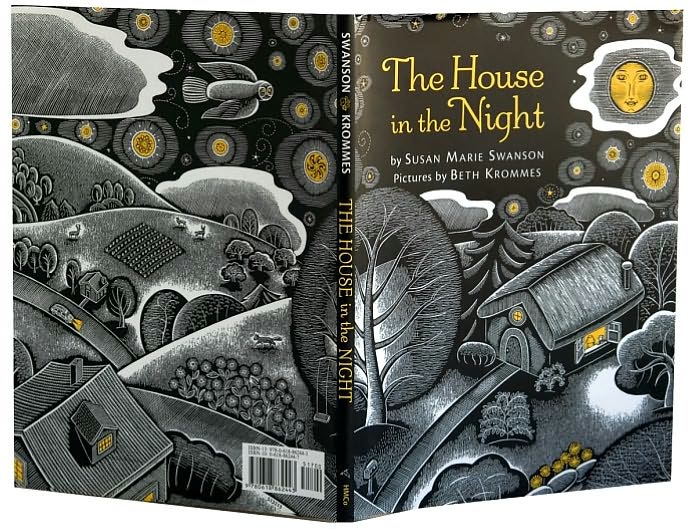
    I do have slightly more of a preference for The House In The Night’s imagery and the way in which that imagery corresponds to the symmetry of the storyline.  I also feel that Krommes’s application of a lack of color with the exception of yellow representing “the light” to be genius in its simplicity despite its distinct ability to relate to and broaden that storyline so comprehensively.  There is little for anyone to wonder about with regard to the book’s worthiness of the Caldecott Award.
    That being said, I still have nothing but high praise for the creators of All The World.  The poetic beauty of Scanlon’s lyrical styling and depth shine as brightly as “the light” from The House In The Night, and Frazee’s artful illustration of sweeping panoramic vistas add any and every last bit of detail for young imaginations to feast upon visually. 
    Having had the experience I did with this book, I’m going to make a point of paying extra close attention not only to those illustrated books that have received the topmost of Caldecott honors, but also those that were in contention for the gold medal as well.  There is a wealth of extremely valuable and superbly assembled work to be explored and I surely would be remiss if, due to any lack of effort on my part, I did not take advantage of the opportunity to become acquainted with it.
    Learning of and understanding about how these two books relate with one another is useful to me as a future teacher of young children, but it is also useful to me as someone who reads.  I would not have been able to convey this experience and extend it to my students, had I not already worked through an exercise such as this text to text comparison.

Friday, January 20, 2012

Possum Magic


Author : Mem Fox
Illustrator : Julie Vivas
Publisher : Houghton Mifflin Harcourt
ISBN : 9780152632243
            (Buy / Borrow)

     Possum Magic by Mem Fox is an excellent example of children’s literature in my opinion.  I’m a big fan of any kind of literature, fiction or non-fiction, that introduces the reader to surroundings that are different than the world in which they currently live.  This is especially important during the earlier years of our lives, when our neurological physiology is undergoing such rapid development.  Experiencing varied imagery and thought processes while we are young will help our brains adapt and accommodate many thoughts, ideas, and points of view, which in turn, will make us more well-rounded individuals over the course of our lives.
    Books like these were a staple of my youth, and I attribute a significant amount of my achievements academically to the care my parents took in helping my sister and I to build our personal libraries as we grew.  I remember having picture books that taught us about the Eiffel tower in Paris and Big Ben in London, and I loved when my parents would sit with us before dinner and read them to us.  After a while, once we already knew the story and would remember it, they would add information that wasn’t contained within the books.  For instance, moving through the book about London and Big Ben lead to questions and conversation about Winston Churchill, World War II, The Beatles, monarchy, and, from what I can remember, American History.  The stories in that book expanded to include history and facts that only increased the curiosity that my sister and I had about the world, the differences between its various countries, and the lives and ideas of notable individuals throughout.
    Later, in elementary school  grades two through five, we were lucky enough to use a series of reading comprehension workbooks (although at the moment, the name escapes me), which also introduced us to people and places that were foreign to us.  I remember learning about the famous Chinese American architect I. M. Pei, a skyscraper called the Bank of China Tower that he designed, and how he oversaw its construction.  I also remember how amazing it was to me that he was born in China, a place I had never been, but also studied at MIT and Harvard in the United States, which were places I’d heard about more frequently.  It definitely helped me to develop my own view of the world and how the pieces of the huge puzzle that I knew as the globe fit together.
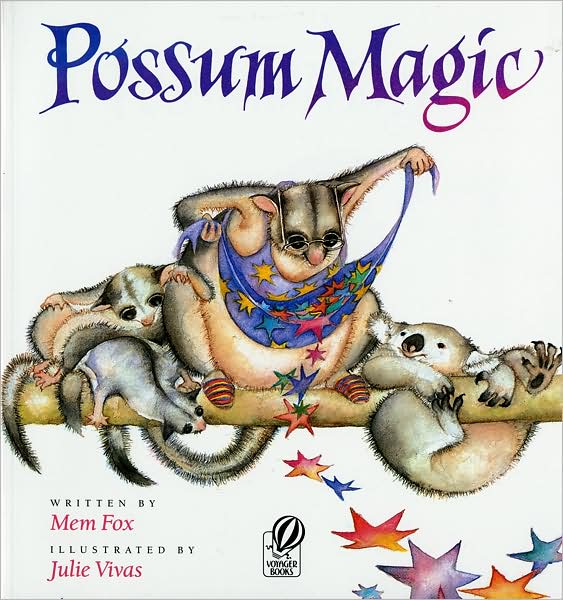
    Just as the books my parents shared with my sister and I brought about questions from us that served to expand the stories further than the pages inside a children’s book, I see Possum Magic providing that same level of depth.  I can easily picture a child asking questions such as “Where is Brisbane”, or “What is Vegemite”, that over the course of time, will turn into a surprising amount of gained knowledge for that child or children.

Thursday, October 07, 2010

Lon Po Po : a Red-Riding Hood story from China (1990 Caldecott Medal Winner)

Author / Illustrator :  Ed Young
Publisher  :  Philomel Books
ISBN  :  0399216197
              (Buy / Borrow)

     You might or might not be surprised by this, depending upon if you've been reading the posts from the start of this humble little blog, but yet again I've found myself having some difficulty choosing a subject for today's entry.  The theme, like before, is something seemingly narrow enough that finding one standout piece shouldn't have been a problem.  It's folk/fairy tales, and while it's true that this category isn't what one might consider all that narrow, I've chosen to explicitly focus on those who have received either the Caldecott Medal or Caldecott Honor.  That should have been easy enough, right?  Wrong.
     Perhaps my joy in rediscovering the genre of picture books has made these selections exponentially more difficult, but when you have the likes of The Three Pigs (David Wiesner), Fables (Arnold Lobel), Rapunzel (Paul O. Zelinsky), and countless other amazingly illustrated Caldecott recipients to choose from, this criteria hardly narrows one's choices.  Ultimately, my choice of a subject this week was based upon three additional factors that I've imposed  :  1.  The book must have been available at my local library,  2.  The book could not have been created by any of the previous authors whose wonderful artwork I've already covered (sorry David Wiesner),  and 3.  The book must have been written and illustrated by the same individual.  I specified the last bit for the same reason I tend to favor the work of Billy Joel over that of Elton John (and lyricist Bernie Taupin).  I am simply amazed by individuals who are capable of creating every aspect of their art form, and do so with such a high level of skill.
     With this extended criteria in hand, I arrived at Lon Po Po as my subject.  As an added bonus, I was treated to a traditional Chinese spin on a story that I've loved since I was a small child, and which has been retold over the course of time in just about every form (books, theatre, animation, live action film).  I realize that, because this sub-genre is folk/fairy tales, the story-line was not entirely "created" by Ed Young.  It is important to remember, however, that he did have to translate it from the original Chinese, and translation is something that can prove to be as difficult as creating a story from the very beginning.  It is that somewhat unique action; an author/illustrator having to finish the book for himself before creating his own version of it for others to finish, that truly spoke to me.
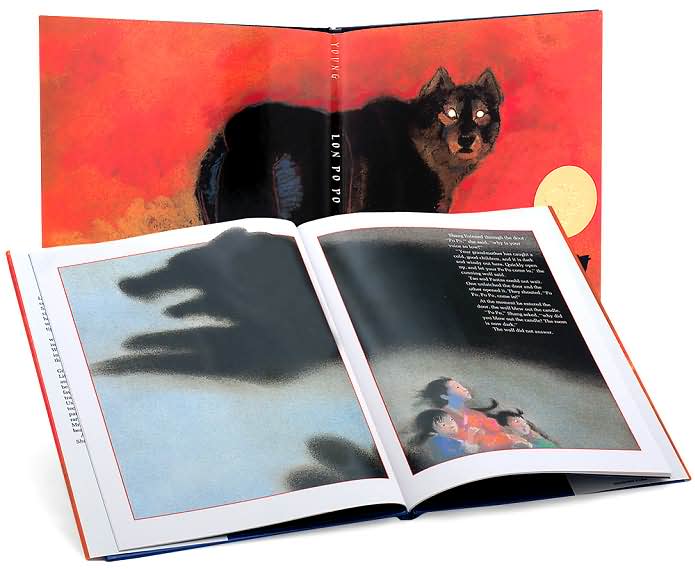
     What I first noticed about this wonderful book, was Mr. Young's decision to integrate panel art, which is a style I've previously only ever seen used in the creation of coromandel screens.  It was a lovely inclusion to see because of its close ties to Chinese culture, and significantly contributes to the overall feel of the story as it progresses.
     Speaking of the progression of the story, I want to express how interesting it is to reflect on the similarities and differences between Lon Po Po and the Little Red Riding Hood story that most American children grew up hearing.  I see a lot of potential for classroom lessons or exercises here, such as the demonstration and application of comparing and contrasting, text to self connections (with included class discussion about which version of the story students prefer and why), or even an art project in which students try to express a certain idea effectively with the use of watercolor painting, similar to the way Ed Young did in his book.
     There is literally something that can be used as a lesson or exercise for students of every learning style in Lon Po Po. More importantly, it is very likely that students will happily embrace activities such as these, further developing their understanding of the underlying concepts and strengthening their knowledge for further application.  I would even go so far as to say that Ed Young and his wonderfully illustrated children's books would be a great way to introduce young American students to author study.  His close connection with his roots in China is very pronounced in his work, and there are many aspects of his life, both as an artist and as a human being, that will fascinate and perhaps even inspire students to investigate and learn.  I know that Lon Po Po has done this for me, and I highly encourage you to find a copy and finish the book as well.