Showing posts with label animals. Show all posts

Friday, January 20, 2012

Possum Magic


Author : Mem Fox
Illustrator : Julie Vivas
Publisher : Houghton Mifflin Harcourt
ISBN : 9780152632243
            (Buy / Borrow)

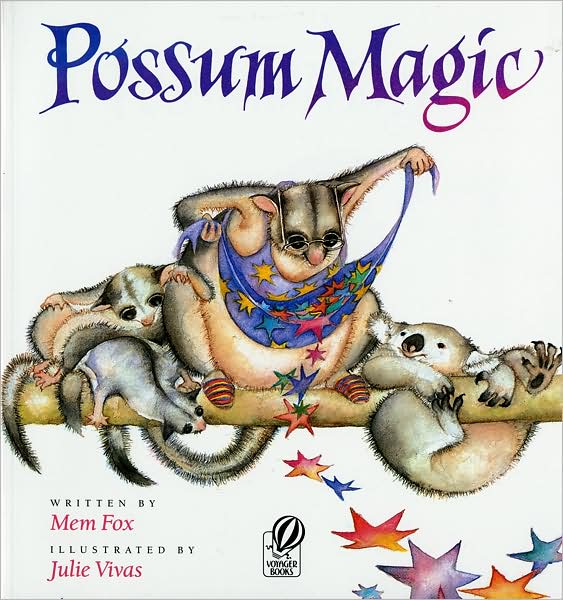
     Possum Magic by Mem Fox is an excellent example of children’s literature in my opinion.  I’m a big fan of any kind of literature, fiction or non-fiction, that introduces the reader to surroundings that are different than the world in which they currently live.  This is especially important during the earlier years of our lives, when our neurological physiology is undergoing such rapid development.  Experiencing varied imagery and thought processes while we are young will help our brains adapt and accommodate many thoughts, ideas, and points of view, which in turn, will make us more well-rounded individuals over the course of our lives.
    Books like these were a staple of my youth, and I attribute a significant amount of my achievements academically to the care my parents took in helping my sister and I to build our personal libraries as we grew.  I remember having picture books that taught us about the Eiffel tower in Paris and Big Ben in London, and I loved when my parents would sit with us before dinner and read them to us.  After a while, once we already knew the story and would remember it, they would add information that wasn’t contained within the books.  For instance, moving through the book about London and Big Ben lead to questions and conversation about Winston Churchill, World War II, The Beatles, monarchy, and, from what I can remember, American History.  The stories in that book expanded to include history and facts that only increased the curiosity that my sister and I had about the world, the differences between its various countries, and the lives and ideas of notable individuals throughout.
    Later, in elementary school  grades two through five, we were lucky enough to use a series of reading comprehension workbooks (although at the moment, the name escapes me), which also introduced us to people and places that were foreign to us.  I remember learning about the famous Chinese American architect I. M. Pei, a skyscraper called the Bank of China Tower that he designed, and how he oversaw its construction.  I also remember how amazing it was to me that he was born in China, a place I had never been, but also studied at MIT and Harvard in the United States, which were places I’d heard about more frequently.  It definitely helped me to develop my own view of the world and how the pieces of the huge puzzle that I knew as the globe fit together.
    Just as the books my parents shared with my sister and I brought about questions from us that served to expand the stories further than the pages inside a children’s book, I see Possum Magic providing that same level of depth.  I can easily picture a child asking questions such as “Where is Brisbane”, or “What is Vegemite”, that over the course of time, will turn into a surprising amount of gained knowledge for that child or children.

Thursday, October 28, 2010

A Visit to William Blake's Inn : Poems for Innocent and Experienced Travelers (1982 Newbery Medal & Caldecott Honor Winner)


Author :  Nancy Willard
Illustrator  :   Alice Provensen
Publisher  :  Harcourt Brace Jovanovich
ISBN  :  0152938222
              (Buy / Borrow)

     Back when I was studying for my undergraduate degree in Computer Science and Mathematics, I came to a point when I thought I was finished with all of the work I needed to do, and was simply biding my time until I received my diploma.  Imagine my surprise, however, when I submitted my application for graduation and found out that I hadn't completed all of my required liberal arts curricula!  I was enraged!  Due to a difference of opinion (and a decidedly unpublicized change in the course description) with regard to whether or not an English class I had taken previously was considered "writing intensive", I still needed to complete an English 110 course to be eligible to graduate.  I was so close to being done, that I didn't put up much of a fight, grudgingly located an English 110 class that didn't start too early in the morning, and signed up for it in my final semester.
     Now, that I'm a little older and much less of a brat, I look back at that class as one of my best experiences in college, and firmly believe that I was made to take it for a reason.  We studied amazing literature like Seamus Heaney's brilliant translation of Beowulf, the insightful and provocative work of Allen Ginsberg, and last, but in no way least, the wonderful poetry of William Blake.  Until that time, I had considered myself a well read individual, possessing a fair bit of knowledge about literature and prominent literary figures.  The most important lesson I learned in that class, though, was that in reality, I hadn't even scratched the surface with regard to such knowledge.  My professor helped me to dive, head first, into the exploration of what is truly awesome work, and I haven't looked back since.  In celebration of that leap, I've chosen this week's subject "A Visit to William Blake's Inn : Poems for Innocent and Experienced Travelers" to cover in my post.
     The title of Willard & Provensen's book is a reference to two of Blake's most celebrated works, "Songs of Innocence" and "Songs of Experience", which are now mostly published as a single volume.  Widely misunderstood by those of his own generation, Blake's contention was that all children are born innocent and as they grow and move toward adulthood, that innocence is lost, making them largely the sum of their life experiences.
     A skilled apprentice of renowned engraver James Basire, he was a visual artist long before he was a literary one.  Using copper plates as his canvas, William meticulously drew his poetry and illustrations onto the metal using acid-resistant material.  Once complete, he would then etch the plates using acid to burn away any copper remaining uncoated.  The plates were then used to print his images on paper which he would paint using watercolor.
     I find it very fitting that Alice Provensen's illustration earned her a 1982 Caldecott Honor, given the artistic beauty which provided the inspiration for her work on this book.  That being said, I must also pay hommage to Nancy Willard's excellent poetry and how well it lends itself to the interpretation and adaptation of Blake's original verses and thoughts.  It is certainly worthy of an award such as the Newbery Medal and I think, sheds a lot of light (no pun intended) onto the key concept he was trying to convey.  As its title suggests, individuals of any age, from innocent to experienced, will be able to glean some special or personal meaning from their visit to William's inn, and that is an experience containing a lot of inherent value, not just for the students, but everyone involved.
     When I think about how I'm going to use this book with elementary school classes in the future, I can hardly contain my enthusiasm.  There are just so many ways in which it can be used in lessons from grades 2 through 5.  For the younger students, it is an amazing example of the use of rhyme, rhythm, and repetition as well as a practically perfect introduction to the the various forms of meter style.  Without even delving beneath the literal meaning of Willard's words, there is much to be learned in the form of vocabulary, history, and basic symbolism.
     With older, more developed students, an educator could begin looking at the deeper meaning behind the poetry, and have them create compositions, art projects, or even poetry of their own in reaction to what they've read.  My first choice for an assignment like this would be the poem "Blake Leads a Walk on the Milky Way", the illustration of which is pictured at the top of this post.  I would structure the exercise with a series of open-ended questions for the students to consider, such as "Is the rat's poor, "sullen" attitude a result of its being presented with boots of iron, while others received those made of emerald, silver, and gold?  Or was it presented with those iron boots because of its sullen negativity?", and "As what kind of metaphor do you think Nancy Willard created this poem?".  I'd be most interested to see the variety of insight among  my students, and would highly encourage them to develop their ideas fully.
     Another intriguing idea, would be to coordinate with teachers from each level to cover "A Visit to William Blake's Inn" several times over the course of grades 2 through 5, having students add to the work they've previously completed, and finishing the book in possession of a volume of their own creation.  A project like this, I feel, would allow them to reflect on their thoughts and ideas over the course of their development and provide them with a certain understanding of themselves that is greater than merely the sum of each lesson's individual parts.  I think this would benefit our students over their entire academic careers too, not just during those years in which they participated in the project.  Imagine, if you will, how much further they will be able to take their ideas when, as they are applying for graduation from their own colleges, they have the great fortune to be told that they need just one more English class.  After all, it was one, Mr. William Blake, who so accurately stated :

"No bird soars too high if he soars with his own wings".


Wednesday, September 29, 2010

My Friend Rabbit by Eric Rohmann (2003 Caldecott Medal Winner)

Author / Illustrator :  Eric Rohmann
Publisher  :  Roaring Brook Press
ISBN  :  0761315357
              (Buy / Borrow)

     I find it both interesting and encouraging that I had quite a bit more difficulty selecting a piece of literature for this week's featured blog entry.  Last week, I think that the sense of urgency I had to find an award winning book, make observations, and form opinions about it within an allotted time frame, led me to choose my subject after only a cursory examination of the possibilities.  Now, having worked through the experience from start to finish already, I am more in tune with what I need to include here and am beginning to understand more about the ways in which I can combine that content with my own vision of what this blog should be.  Fortunately (or unfortunately, depending upon your point of view), this has meant that I have devoted a bit more time and effort to the selection made for today's entry and I hope this careful consideration will translate to a better and more thought provoking experience for my readers this week.
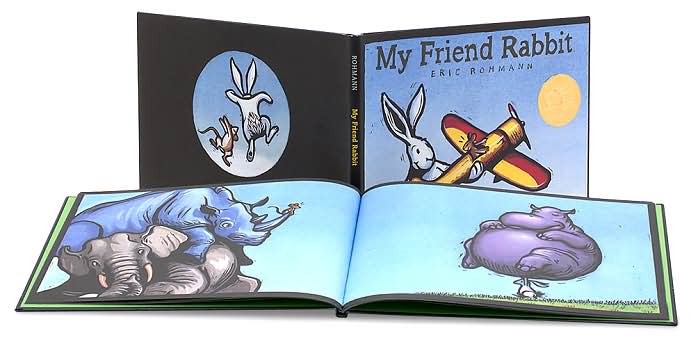
    As shown above, I have chosen the Caldecott Award winning book My Friend Rabbit to write about today, for several reasons.  The storyline is an excellent tale for young people to read about, understand, and relate with.  The style of the illustration, though quite different from last week's selection Tuesday, is just as superb and dimensionally dynamic.  What struck me most about it, wasn't only how artistically skilled Eric Rohmann obviously is, but also his ability to effortlessly include so much comical detail in his pictures.  There wasn't one page that I turned during the several times that I read through this book that I didn't smile or laugh a little bit, and I think that this quality is essential for holding a young person's interest.  It is a quality that allows them to not only read, but also finish the book.
     After my experience with My Friend Rabbit, I was struck with a bout of nostalgia that brought me back to some adventures (and misadventures) of which I was a part with both my childhood friends and my sister.  In many cases I can clearly remember oddly contrived schemes that ultimately ended badly for one or more of the parties involved, yet throughout there was never a doubt of our close relationship or the esteem in which we held one another.  This feeling, is what Eric Rohmann has captured so well in both his written words and in the way Mouse and Rabbit interact with one another.  He allows his readers the greatest level of ease when it comes to identifying with the characters in the book and the bond between them.
     My next thoughts, were of how many ways this book could be used in a group or classroom setting, because there are so many.  While it is not specifically written as a counting lesson, for instance, it could certainly be used as one.  As rabbit gathers his animal friends up to form the giant tower that he plans to use to recover Mouse's airplane, a group or class could count along to see how many animals high the tower goes.
     Another lesson/activity that could be derived from this story is about diversity and the beauty in different individuals coming together and working toward a common goal and purpose.  It introduces complex concepts such as metaphors to young people in a way that is plain to see and easy to understand.  I find this to be an especially important idea to demonstrate in classrooms today, where the students that make up many of our classes come from a wide variety of racial, ethnic, and cultural backgrounds.
     The last idea for a lesson or activity that I have to mention is also my favorite.  It came to me as I was looking over some of my bookmarked news stories from 2009.  One in particular caught my attention, and I thought it would be wonderful to use with a group or class as a demonstration of text to life comparison. 
     It is the story of Bella and Tarra, a dog and an elephant living at an elephant sanctuary in Hohenwald, Tennessee, that are real-life best friends, just like Mouse and Rabbit.  True, Bella and Tarra might not have ever had to address an issue such as an airplane caught in a tree, but the depth of their friendship, after having read their story, is just as obvious and in my opinion, even more heartwarming. 
     I am grateful for the experience of having read both of these stories, one fiction and one non-fiction, and being able to understand the connections that can be made between them.  Depending on your own point of view, it's art imitating life or life imitating art, but either way you choose to look at it, it's a lovely way to finish the book.

Wednesday, September 22, 2010

Tuesday by David Wiesner (1992 Caldecott Medal Winner)

Author / Illustrator :  David Wiesner
Publisher  :  Clarion Books
ISBN  :  0395870828
              (Buy / Borrow)

     As previously mentioned, I am an avid proponent of reading and exposure to literature in all shapes and sizes.  As of late, however, I must admit that my own exposure to picture books and illustrated material in general (other than advertisements), has been somewhat lacking.  I'm glad, now that I'm involved in a class covering children's literature, that I am reconnecting with the types of books I very much adored during my early childhood.
     During my visit to the Port Richmond branch of the New York Public Library yesterday, I searched for as many Newbery and Caldecott award winning books as I could find on the shelves.  I was fortunate to find that not only were many of them currently on the premises, but also that there were several copies.  After making a few selections I decided to write my post about David Wiesner's book Tuesday, because, after all, I was checking it out on a Tuesday, and couldn't wait to see what was in store for the rest of my day!
     I settled in at home at about 6:15 PM, opened to the first page and read "Tuesday Evening. Around Eight".  Those were the only words on that page.  In fact, that page had the only real words used in the entire book.  The only other text denoted the progress of time as the story unfolded.  At first, I was a little put off by this fact.  How, after all, would I be able to comment on a book that had essentially no words?
     I read through it a few more times, each time reminding myself that the Caldecott Medal is for distinguished illustration and I was surprised at how much detail I had overlooked during my previous examinations of the artwork.  As the old adage goes "A picture is worth a thousand words", and in the case of Tuesday, probably a whole lot more.
     There is a wonderfully detailed story contained within this sequence of images and I think that this book would be great to "read" in a group or classroom setting containing children of all different reading levels.  True, they wouldn't actually be reading words on a page, but everyone would be able to infer many of the same elements of the story and share in the experience.
     I feel that this shared experience (hopefully an enthusiastic one), would provide a common ground on which all students could meet and possibly discuss their thoughts.  The effect of this collaborative experience can and more than likely will stimulate and reinforce the efforts of the children to further develop their reading skills.  I think it's important that children have as many positive experiences with reading as they can early on.  That way, they won't feel that reading is a chore or something that they have to do for school, but rather something that they would like to do for fun.  If they are enjoying themselves, they'll be more likely to continue reading, and if they continue reading, there will be virtually no limit to what they will be able to learn.
     I strongly recommend that anyone looking for a superbly illustrated picture book from which a vivid and imaginative storyline can be derived, should find a copy of Tuesday at their local bookstore.  It will undoubtedly be a great addition to any collection.