Showing posts with label approach to education. Show all posts
Friday, January 20, 2012
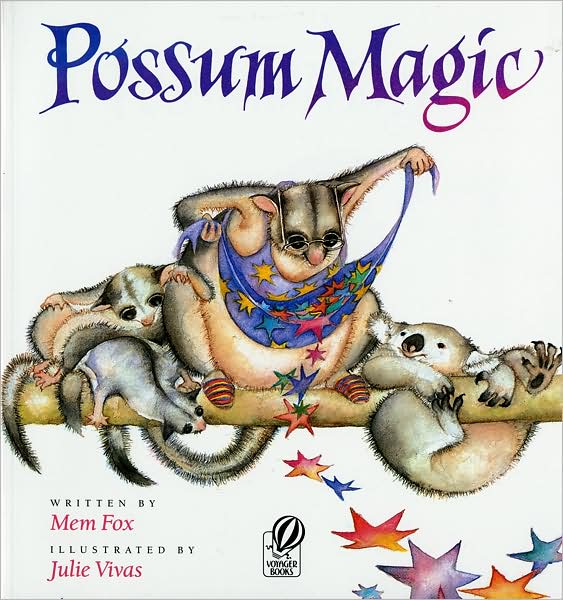
Possum Magic
Author : Mem Fox
Illustrator : Julie Vivas
Publisher : Houghton Mifflin Harcourt
ISBN : 9780152632243
(Buy / Borrow)
Possum Magic by Mem Fox is an excellent example of children’s literature in my opinion. I’m a big fan of any kind of literature, fiction or non-fiction, that introduces the reader to surroundings that are different than the world in which they currently live. This is especially important during the earlier years of our lives, when our neurological physiology is undergoing such rapid development. Experiencing varied imagery and thought processes while we are young will help our brains adapt and accommodate many thoughts, ideas, and points of view, which in turn, will make us more well-rounded individuals over the course of our lives.
Books like these were a staple of my youth, and I attribute a significant amount of my achievements academically to the care my parents took in helping my sister and I to build our personal libraries as we grew. I remember having picture books that taught us about the Eiffel tower in Paris and Big Ben in London, and I loved when my parents would sit with us before dinner and read them to us. After a while, once we already knew the story and would remember it, they would add information that wasn’t contained within the books. For instance, moving through the book about London and Big Ben lead to questions and conversation about Winston Churchill, World War II, The Beatles, monarchy, and, from what I can remember, American History. The stories in that book expanded to include history and facts that only increased the curiosity that my sister and I had about the world, the differences between its various countries, and the lives and ideas of notable individuals throughout.
Later, in elementary school grades two through five, we were lucky enough to use a series of reading comprehension workbooks (although at the moment, the name escapes me), which also introduced us to people and places that were foreign to us. I remember learning about the famous Chinese American architect I. M. Pei, a skyscraper called the Bank of China Tower that he designed, and how he oversaw its construction. I also remember how amazing it was to me that he was born in China, a place I had never been, but also studied at MIT and Harvard in the United States, which were places I’d heard about more frequently. It definitely helped me to develop my own view of the world and how the pieces of the huge puzzle that I knew as the globe fit together.
Just as the books my parents shared with my sister and I brought about questions from us that served to expand the stories further than the pages inside a children’s book, I see Possum Magic providing that same level of depth. I can easily picture a child asking questions such as “Where is Brisbane”, or “What is Vegemite”, that over the course of time, will turn into a surprising amount of gained knowledge for that child or children.
Labels:
1991,
animals,
approach to education,
children's literature,
chinese,
elementary education,
fiction,
illustrator,
Julie Vivas,
Lanza,
Mem Fox,
picture book,
Possum Magic,
questioning,
teaching
Friday, October 01, 2010
A Slight Divergence
I know that the focus of this blog is supposed to be children's literature and about how much of our responsibility as teachers entails a wise selection of the proper materials, but as I mentioned in my previous entry, I was looking through some bookmarked news stories recently, and have come across another one that I feel compelled to share in this space.
It is no secret that the systems of education in the US have been consistently failing to achieve their intended goals of improving our internationally ranked level of student achievement. Over the past several decades there have been innumerable changes, reforms, and budgetary restructuring plans put into action in an attempt to recapture the status once held by our nation's schools, but so far the results have been marginal at best.
I wouldn't even know where to begin to address the issues facing the "educational renaissance" that it seems we as a nation must attempt to undertake, but what I do have is a curiosity when it comes to what is working for schools, teachers, and students in other parts of the world. Yes, I understand that other countries' systems have many problems and deficiencies of their own. I also know that in most cases, a direct application of their seemingly good methods or practices would be more difficult to implement in America, given the much more highly diverse populations of students in our classrooms, but as you'll see from the video embedded below, there are interesting ideas, such as teacher re-education in other countries that act as a sort of "No Teacher Left Behind" program. I can't help but think that we would benefit from more widespread use of something like this here in America.
It has always been my contention that the best teachers under whom I've studied have also been those who recognize their own need to be eternal students. I know that this is the reason that I've returned to school myself, and my purpose in creating this post is not specifically to have my readers agree or disagree with the point of view provided. It's just here to (hopefully) make you think, wonder, and question. I'll leave you now to watch the video below, but before I go, I would like to borrow these few parting words from renowned author and 1988 Nobel Laureate in Literature, Naguib Mahfouz :
"You can tell whether a man is clever by his answers. You can tell whether a man is wise by his questions."
Labels:
approach to education,
elementary education,
japan,
japanese,
Lanza,
points to ponder,
teaching
Subscribe to:
Posts (Atom)