Author / Illustrator : Ed Young
Publisher : Philomel Books
ISBN : 0399216197
(Buy / Borrow)
You might or might not be surprised by this, depending upon if you've been reading the posts from the start of this humble little blog, but yet again I've found myself having some difficulty choosing a subject for today's entry. The theme, like before, is something seemingly narrow enough that finding one standout piece shouldn't have been a problem. It's folk/fairy tales, and while it's true that this category isn't what one might consider all that narrow, I've chosen to explicitly focus on those who have received either the Caldecott Medal or Caldecott Honor. That should have been easy enough, right? Wrong.
Perhaps my joy in rediscovering the genre of picture books has made these selections exponentially more difficult, but when you have the likes of The Three Pigs (David Wiesner), Fables (Arnold Lobel), Rapunzel (Paul O. Zelinsky), and countless other amazingly illustrated Caldecott recipients to choose from, this criteria hardly narrows one's choices. Ultimately, my choice of a subject this week was based upon three additional factors that I've imposed : 1. The book must have been available at my local library, 2. The book could not have been created by any of the previous authors whose wonderful artwork I've already covered (sorry David Wiesner), and 3. The book must have been written and illustrated by the same individual. I specified the last bit for the same reason I tend to favor the work of Billy Joel over that of Elton John (and lyricist Bernie Taupin). I am simply amazed by individuals who are capable of creating every aspect of their art form, and do so with such a high level of skill.
With this extended criteria in hand, I arrived at Lon Po Po as my subject. As an added bonus, I was treated to a traditional Chinese spin on a story that I've loved since I was a small child, and which has been retold over the course of time in just about every form (books, theatre, animation, live action film). I realize that, because this sub-genre is folk/fairy tales, the story-line was not entirely "created" by Ed Young. It is important to remember, however, that he did have to translate it from the original Chinese, and translation is something that can prove to be as difficult as creating a story from the very beginning. It is that somewhat unique action; an author/illustrator having to finish the book for himself before creating his own version of it for others to finish, that truly spoke to me.
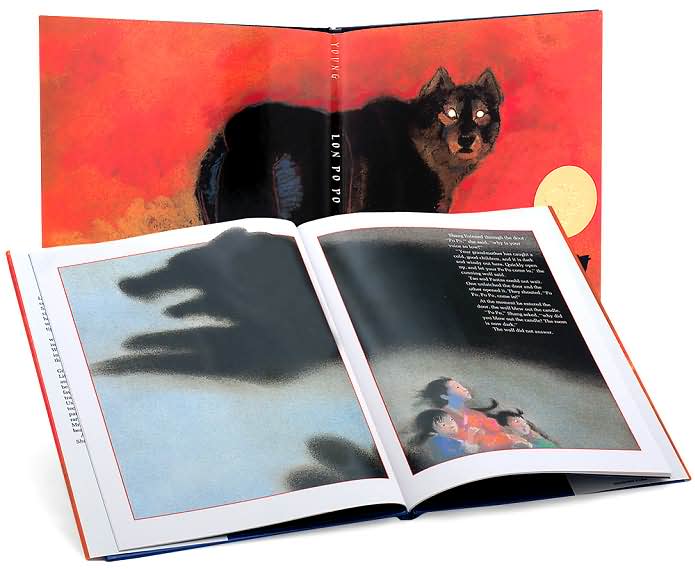
What I first noticed about this wonderful book, was Mr. Young's decision to integrate panel art, which is a style I've previously only ever seen used in the creation of coromandel screens. It was a lovely inclusion to see because of its close ties to Chinese culture, and significantly contributes to the overall feel of the story as it progresses.
Speaking of the progression of the story, I want to express how interesting it is to reflect on the similarities and differences between Lon Po Po and the Little Red Riding Hood story that most American children grew up hearing. I see a lot of potential for classroom lessons or exercises here, such as the demonstration and application of comparing and contrasting, text to self connections (with included class discussion about which version of the story students prefer and why), or even an art project in which students try to express a certain idea effectively with the use of watercolor painting, similar to the way Ed Young did in his book.
There is literally something that can be used as a lesson or exercise for students of every learning style in Lon Po Po. More importantly, it is very likely that students will happily embrace activities such as these, further developing their understanding of the underlying concepts and strengthening their knowledge for further application. I would even go so far as to say that Ed Young and his wonderfully illustrated children's books would be a great way to introduce young American students to author study. His close connection with his roots in China is very pronounced in his work, and there are many aspects of his life, both as an artist and as a human being, that will fascinate and perhaps even inspire students to investigate and learn. I know that Lon Po Po has done this for me, and I highly encourage you to find a copy and finish the book as well.
Showing posts with label ede652. Show all posts
Thursday, October 07, 2010
Wednesday, September 29, 2010
My Friend Rabbit by Eric Rohmann (2003 Caldecott Medal Winner)
Author / Illustrator : Eric Rohmann
Publisher : Roaring Brook Press
ISBN : 0761315357
(Buy / Borrow)
I find it both interesting and encouraging that I had quite a bit more difficulty selecting a piece of literature for this week's featured blog entry. Last week, I think that the sense of urgency I had to find an award winning book, make observations, and form opinions about it within an allotted time frame, led me to choose my subject after only a cursory examination of the possibilities. Now, having worked through the experience from start to finish already, I am more in tune with what I need to include here and am beginning to understand more about the ways in which I can combine that content with my own vision of what this blog should be. Fortunately (or unfortunately, depending upon your point of view), this has meant that I have devoted a bit more time and effort to the selection made for today's entry and I hope this careful consideration will translate to a better and more thought provoking experience for my readers this week.
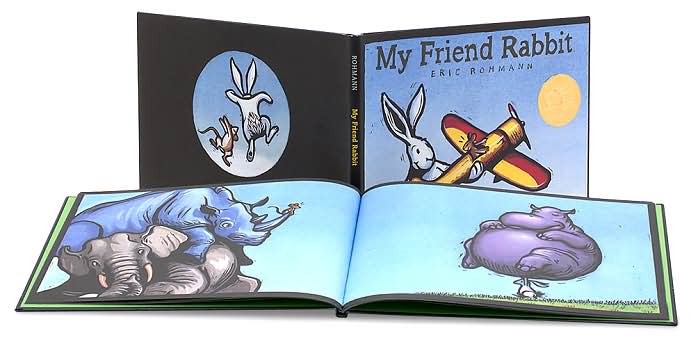
As shown above, I have chosen the Caldecott Award winning book My Friend Rabbit to write about today, for several reasons. The storyline is an excellent tale for young people to read about, understand, and relate with. The style of the illustration, though quite different from last week's selection Tuesday, is just as superb and dimensionally dynamic. What struck me most about it, wasn't only how artistically skilled Eric Rohmann obviously is, but also his ability to effortlessly include so much comical detail in his pictures. There wasn't one page that I turned during the several times that I read through this book that I didn't smile or laugh a little bit, and I think that this quality is essential for holding a young person's interest. It is a quality that allows them to not only read, but also finish the book.
After my experience with My Friend Rabbit, I was struck with a bout of nostalgia that brought me back to some adventures (and misadventures) of which I was a part with both my childhood friends and my sister. In many cases I can clearly remember oddly contrived schemes that ultimately ended badly for one or more of the parties involved, yet throughout there was never a doubt of our close relationship or the esteem in which we held one another. This feeling, is what Eric Rohmann has captured so well in both his written words and in the way Mouse and Rabbit interact with one another. He allows his readers the greatest level of ease when it comes to identifying with the characters in the book and the bond between them.
My next thoughts, were of how many ways this book could be used in a group or classroom setting, because there are so many. While it is not specifically written as a counting lesson, for instance, it could certainly be used as one. As rabbit gathers his animal friends up to form the giant tower that he plans to use to recover Mouse's airplane, a group or class could count along to see how many animals high the tower goes.
Another lesson/activity that could be derived from this story is about diversity and the beauty in different individuals coming together and working toward a common goal and purpose. It introduces complex concepts such as metaphors to young people in a way that is plain to see and easy to understand. I find this to be an especially important idea to demonstrate in classrooms today, where the students that make up many of our classes come from a wide variety of racial, ethnic, and cultural backgrounds.
The last idea for a lesson or activity that I have to mention is also my favorite. It came to me as I was looking over some of my bookmarked news stories from 2009. One in particular caught my attention, and I thought it would be wonderful to use with a group or class as a demonstration of text to life comparison.
It is the story of Bella and Tarra, a dog and an elephant living at an elephant sanctuary in Hohenwald, Tennessee, that are real-life best friends, just like Mouse and Rabbit. True, Bella and Tarra might not have ever had to address an issue such as an airplane caught in a tree, but the depth of their friendship, after having read their story, is just as obvious and in my opinion, even more heartwarming.
I am grateful for the experience of having read both of these stories, one fiction and one non-fiction, and being able to understand the connections that can be made between them. Depending on your own point of view, it's art imitating life or life imitating art, but either way you choose to look at it, it's a lovely way to finish the book.
Labels:
2003,
American,
animals,
caldecott medal winner,
children's literature,
college of staten island,
ede652,
elementary education,
Eric Rohmann,
fiction,
friendship,
illustrator,
Lanza,
text to life
Wednesday, September 22, 2010
Tuesday by David Wiesner (1992 Caldecott Medal Winner)
Author / Illustrator : David Wiesner
Publisher : Clarion Books
ISBN : 0395870828
(Buy / Borrow)
As previously mentioned, I am an avid proponent of reading and exposure to literature in all shapes and sizes. As of late, however, I must admit that my own exposure to picture books and illustrated material in general (other than advertisements), has been somewhat lacking. I'm glad, now that I'm involved in a class covering children's literature, that I am reconnecting with the types of books I very much adored during my early childhood.
During my visit to the Port Richmond branch of the New York Public Library yesterday, I searched for as many Newbery and Caldecott award winning books as I could find on the shelves. I was fortunate to find that not only were many of them currently on the premises, but also that there were several copies. After making a few selections I decided to write my post about David Wiesner's book Tuesday, because, after all, I was checking it out on a Tuesday, and couldn't wait to see what was in store for the rest of my day!
I settled in at home at about 6:15 PM, opened to the first page and read "Tuesday Evening. Around Eight". Those were the only words on that page. In fact, that page had the only real words used in the entire book. The only other text denoted the progress of time as the story unfolded. At first, I was a little put off by this fact. How, after all, would I be able to comment on a book that had essentially no words?
I read through it a few more times, each time reminding myself that the Caldecott Medal is for distinguished illustration and I was surprised at how much detail I had overlooked during my previous examinations of the artwork. As the old adage goes "A picture is worth a thousand words", and in the case of Tuesday, probably a whole lot more.
There is a wonderfully detailed story contained within this sequence of images and I think that this book would be great to "read" in a group or classroom setting containing children of all different reading levels. True, they wouldn't actually be reading words on a page, but everyone would be able to infer many of the same elements of the story and share in the experience.
I feel that this shared experience (hopefully an enthusiastic one), would provide a common ground on which all students could meet and possibly discuss their thoughts. The effect of this collaborative experience can and more than likely will stimulate and reinforce the efforts of the children to further develop their reading skills. I think it's important that children have as many positive experiences with reading as they can early on. That way, they won't feel that reading is a chore or something that they have to do for school, but rather something that they would like to do for fun. If they are enjoying themselves, they'll be more likely to continue reading, and if they continue reading, there will be virtually no limit to what they will be able to learn.
I strongly recommend that anyone looking for a superbly illustrated picture book from which a vivid and imaginative storyline can be derived, should find a copy of Tuesday at their local bookstore. It will undoubtedly be a great addition to any collection.
Labels:
1992,
American,
animals,
caldecott,
caldecott medal winner,
children's literature,
college of staten island,
David Wiesner,
ede652,
elementary education,
fantasy,
fiction,
illustrator,
Lanza
Once Upon A Time. . . . .
Hello, and welcome to the very first post on my blog about children's literature. Before I dive right into posting and exploring the myriad of material published for young people, I wanted to write a few words about the blog itself and its purpose.
While it is true that this blog is a part of the curriculum for a class examining children's literature, I aspire to make it more than just an assignment. I feel that I owe much of my development, both as a student and a human being, to reading and being read to over the course my own childhood. The title chosen for this tiny corner of the digital realm that is the internet was done so quite carefully. Finish The Book, for the purpose of the posts made here, will have more than one meaning.
The literal meaning, of course, is an open encouragement to all readers, both young and young at heart, to read. Whatever your preference, be it biographies, poetry, magazines, newspapers, or even humble little blogs, the value of reading can never be underestimated.
The deeper meaning of the title is borrowed from a statement by renowned author and literature critic Samuel Johnson. “A writer only begins a book. A reader finishes it." Nowhere have I seen an idea more true or profound. After reading that quote for the first time and digesting its meaning, I realized that the ways in which we process literature in our own minds are what truly make reading a unique and personal experience. Not solely about the joy of imagination, reading can also serve to help us expand our own ideas or even absorb and grow in the understanding of new ones. There are very few experiences that can claim to be as remarkable, reliable, or sustainable.
As you might have noticed, reading and its inherent benefits are a passionate subject for me, and I hope the enthusiasm contained within the posts on this blog serve to boost your enthusiasm as well. Thanks for reading! I'll see you soon :)
Subscribe to:
Posts (Atom)